Paradigm
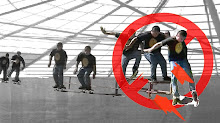
Skate the City Activate the City Own the City A skateboarder crisscrosses the city down sidewalks, through the streets with no particular destination, just an indirect path taking him from waxed curb to bench to handrail to hip. As he shifts from feature to feature, he occasionally stops at one to take a second and third run at a handrail or a hipped curb each time performing a different variation of ollie to slide or grind. He approaches two driveways separated by a six-foot long hip. As he gets closer, his concentration intensifies until his complete focus is on ollying the space between the two driveways.
He ollies and for that brief moment in time, while he’s in mid-air, his mind is completely and unquestionably concentrated on grabbing the skateboard frontside and tweaking it out before landing on the far side of the hip. In that moment there are no thoughts of school, work, family, politics or anything else that may have been on his mind a minute ago. He is completely within that moment.
As he lands, a brief smile curls up the corners of his mouth as he articulates a  new destination and starts heading toward a building two blocks away that has benches and a handrail. Half of a block down he notices another hip between two driveways and proceeds to ollie it. As he approaches the hip and his concentration begins to focus on the performance, a crack in the sidewalk grabs his skateboard and holds on as he keeps going, briefly, and slams down on the sidewalk.

 As he picks himself up, he looks at the crack and wonders where it came from and why he didn’t see it. He grabs his skateboard and makes a second run at the hip, ollies to tail grab, stops, and makes a third run. Then a fourth. He was doing more than
 occupying the space temporarily, he was owning the space.
He continues to the next location to skate the benches and handrails, to activate the city. Everytime he crosses this part of the city, he alters his course so he can stop and ollie the hip where the crack in the sidewalk that once grabbed his attention is. The space he now owns.
Nomadic Subcultures of an Urban Environment
Within any urban setting, there are multiple subcultures already dependent on mobility or any variety of the idea of mobility. It is this  mobile element that is in opposition to the institution of architecture and its connotations of permanence and stability.
Here in San Diego, there is a large homeless population who navigate the streets daily. Due to the “No Loitering” laws, they must be ready to move at any moment and take their  belongings with. Though they may often inhabit the same neighborhoods for long periods of time, they will usually move around during the day and need to be able to store their
 belongings which can include extra clothing, bedding, and eating utensils in the nooks and voids of the city.
 There are other models of mobile architecture in San Diego seen in the farmers’ markets that occur in different locations in the city each day and the Swap Meets that occur in vacant parking lots on the weekends. These markets are constructed, deconstructed, and moved around to different locations
 everyday. The ease of this type of construction allows not only for the mobility of the architecture, but also its recyclability, an essential element of nomadic life.
Other forms of temporal inhabitation can be seen in the idea of the trailer parks. Although they typically stay in a location for  many years, the mobile home is essentially a house that is designed to be moved easily. Because of the simple construction, it is also easily modified to fit future needs.
Many aspects of contemporary youth culture also reflect a desire for mobility from the example of the skateboarder moving through the city, to the people traveling around the world. Raves are also a youth phenomenon with a mobile  element. Because of their illegal nature, they must take place in a different location each time. Burning Man, a music festival that takes place in Northeastern California or Nevada where an ephemeral city is constructed in the desert of for a long weekend every year in the fall. Nomadic behavior is not a new or even ancient phenomenon, but an ongoing struggle between the fixed and the unfixed that is always taking place.
Studio 3B: Balwin Hills Park Charette
The goal of this design exercise is to integrate a 57-acre park into the urban fabric of Los Angeles, California. Part of this exercise is to pick a word and use it in the expression of the concept. The word I chose for this project is gravity.
For this project, skateboarding is used as an illustration of gravity as a design concept. This is achieved by incorporating a skateboard park covering several acres into the existing park.
This idea is reinforced first by carving out the hillside with multiple levels for the skate park all connected through a series of "roll-in ramps."
It is further developed by designing concrete walks throughout the park that transition on the sides onto the retaining walls and curbs. In some places the transition curves up just a little while in others, it curves up much higher, some even overhead.
Walks are designed to be "skate-able" and are also fully accessible to pedestrians while wrapping around and through the park providing impressive views of the vast urban landscape of Los Angeles.
Skateboarding was chosen as an expression of gravity because it (gravity) is one of the two factors that govern the physical act of skateboarding. The other being friction. But more importantly, building a massive skate park covering several acres of the hillside is an expression of an inherently urban culture that already exists in every city in the world.

This project was a two week long charette in the middle of the spring semester 2003 taught by Tal Safdie and Ricardo Rabines. This concept was presented using eight 11X17 images lined up horizontally reading from left to right.